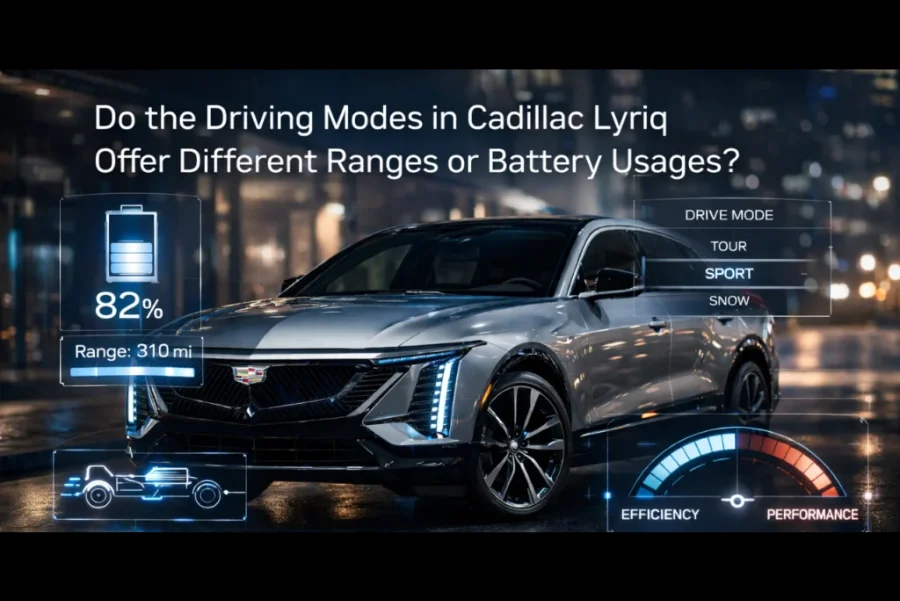

Do the driving modes in cadillac lyriq offer different ranges or battery usages?: If you own or are considering the Cadillac Lyriq, one of the most practical questions you’ll ask is simple: Will changing driving modes affect how far I can go on a charge? When you’re planning a road trip, commuting daily, or managing winter driving, range isn’t just a number — it’s peace of mind.
The short answer is yes, driving modes can affect your real-world range. But not because the battery physically changes. The battery size remains the same no matter which mode you select. What changes is how quickly energy is used and how efficiently it is recovered.
Driving modes control how fast you press the gas pedal, how aggressively the vehicle responds, and how much energy you recover when slowing down. Those small behavioral and software adjustments can add up over a full charge cycle.
So the real difference isn’t battery size — it’s the rate of energy consumption. And that’s what we’ll break down clearly in the sections below.
How Driving Modes Work in the Cadillac Lyriq (What Actually Changes)
In the Cadillac Lyriq, driving modes are software-controlled profiles. They don’t modify the hardware. The battery pack, motor, and overall power capacity remain identical across modes. What changes is how the vehicle uses that power.
Behind the scenes, each mode adjusts several key variables. Throttle sensitivity determines how quickly the vehicle responds when you press the accelerator. Power delivery timing affects how aggressively torque is sent to the wheels. Regenerative braking strength changes how much energy is recaptured when you slow down. Steering feel and traction control are also tuned differently depending on the selected mode.
In some situations, even climate system behavior can subtly shift. For example, performance-oriented driving may indirectly increase HVAC usage due to higher cabin cooling demands.
All of these adjustments are small individually. But together, they influence total energy usage over time. That’s why drivers may notice different real-world range results even though the battery itself hasn’t changed at all.
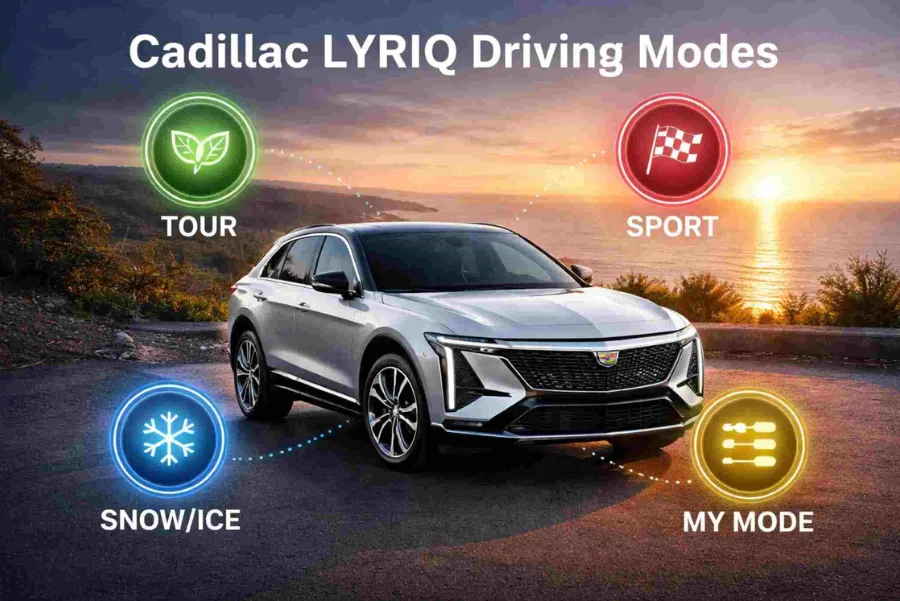
Tour Mode: The Best Choice for Maximum Range?
Tour Mode is the default setting in the Lyriq, and it’s designed to balance comfort and efficiency. If your priority is maximizing range, this is usually the safest choice.
In Tour Mode, acceleration is gradual and smooth. Instead of delivering instant torque aggressively, the vehicle increases power in a controlled way. That reduces sudden energy spikes that can quickly drain the battery. Regenerative braking is balanced — strong enough to recover energy, but not so aggressive that it disrupts the driving experience. Power delivery remains steady, which is ideal for highway cruising and daily commuting.
For most drivers, Tour Mode delivers results closest to EPA estimates. That’s because EPA testing simulates moderate driving behavior, which aligns closely with how Tour Mode is calibrated.
If you want consistency and predictable range, especially on longer trips, Tour Mode is typically the most efficient baseline.
Sport Mode: Why Performance Costs You Miles
Sport Mode changes the personality of the Lyriq immediately. Throttle response becomes sharper. Acceleration feels quicker. Steering tightens. The vehicle feels more energetic overall. But that performance comes at a cost.
When acceleration becomes more aggressive, the battery must deliver higher current output. Rapid bursts of torque consume significantly more energy than gradual acceleration. Additionally, Sport Mode often reduces emphasis on regenerative braking, allowing smoother coasting rather than strong energy recovery when lifting off the pedal.
In real-world conditions, drivers can see range reductions of around 10–20%, depending heavily on driving habits. The key factor isn’t just the mode — it’s how the mode influences behavior. Drivers tend to accelerate harder and maintain higher speeds when in Sport Mode, which compounds energy usage.
So while Sport Mode doesn’t permanently reduce range capacity, it absolutely increases consumption rate. It’s perfect for responsiveness and short drives — just not for maximizing miles per charge.
Snow/Ice Mode: Does It Save Battery or Reduce It?
Snow/Ice Mode is designed for traction and stability, not efficiency. It softens throttle response and carefully manages torque delivery to prevent wheel slip. Stability systems intervene more frequently to maintain control in slippery conditions.
In theory, gentler acceleration could reduce energy usage. However, real-world winter conditions complicate things. Cold temperatures reduce battery efficiency. Cabin heating requires additional energy. Tires experience higher rolling resistance. All of these factors affect range more than the mode itself.
So while Snow/Ice Mode does limit aggressive power draw, winter driving often results in lower overall range regardless of the selected mode. The reduction isn’t caused by the setting alone — it’s largely environmental. The priority here is safety, not range optimization.
My Mode: Custom Settings, Custom Battery Usage
My Mode allows drivers to personalize throttle feel, steering weight, and regenerative braking strength. Because of that flexibility, its impact on range varies entirely based on configuration.
If you choose gentle throttle response and stronger regenerative braking, My Mode can match or even slightly outperform Tour Mode in city driving. Strong regeneration helps capture more energy during frequent stops, which adds up in urban traffic.
On the other hand, if you configure My Mode for sharper acceleration and lighter regen, consumption can resemble Sport Mode levels.
The benefit of My Mode is balance. You can tailor the vehicle to your comfort preferences while still keeping efficiency in mind. It becomes less about fixed presets and more about personal optimization.
Other Factors That Impact Range More Than Driving Mode
Driving mode matters — but other factors often matter more. Speed is a major one. Even in Tour Mode, sustained high-speed driving will reduce range faster than moderate cruising.
Terrain also plays a role. Climbing hills demands significant energy. While regenerative braking recovers some energy on descents, uphill climbs typically consume more than you get back. Temperature significantly affects battery performance. Cold weather slows battery chemistry and increases HVAC demand. Hot weather increases air conditioning use. Both reduce effective range.
Finally, driving style is crucial. Smooth acceleration and gradual braking preserve energy. Aggressive driving drains it quickly — regardless of the selected mode. In many cases, the driver has more influence over range than the driving mode itself.
Do Cadillac Lyriq Driving Modes Really Change Range and Battery Consumption?
Yes — but not because the battery itself changes. The Cadillac Lyriq uses the same battery pack in every mode. What changes is how the vehicle delivers power and how efficiently it recovers energy while driving. Tour Mode is tuned for balance and smooth acceleration, which helps conserve energy and usually delivers the best real-world range. It’s the most efficient option for daily driving and long trips.
Sport Mode increases throttle sensitivity and acceleration. That stronger power demand pulls more energy from the battery, which can reduce range — sometimes noticeably — especially if you drive aggressively. Snow/Ice Mode focuses on stability and traction. While it softens power delivery, winter conditions like cold temperatures and cabin heating typically reduce range more than the mode itself.
My Mode depends entirely on your settings. Configure it gently, and it can match Tour Mode efficiency. Set it aggressively, and consumption increases. In short, modes influence energy usage — but your driving style and conditions matter even more.
Does Switching Modes Mid-Drive Affect Efficiency?
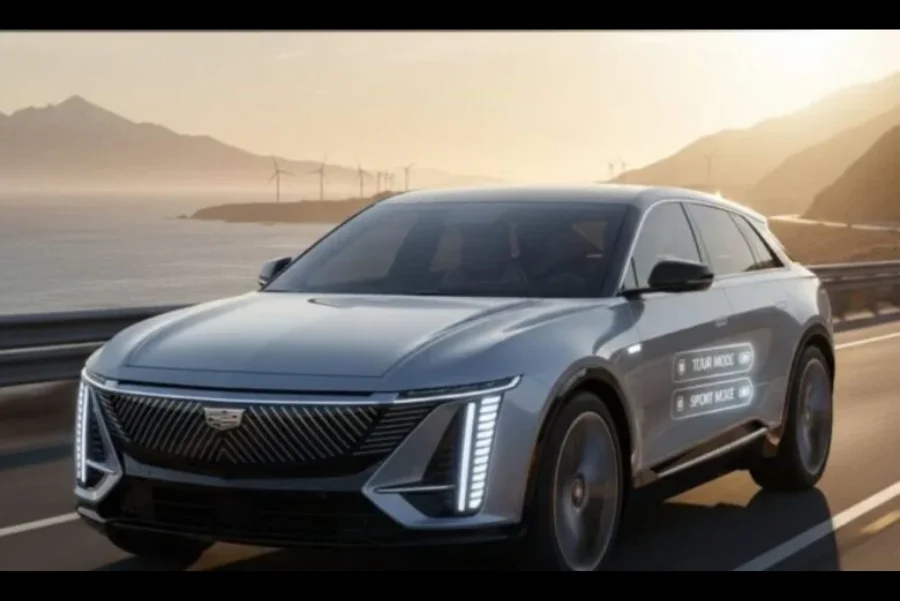
Many Lyriq drivers wonder if changing driving modes while on the road can save energy or hurt efficiency. The short answer is: yes, but the effect is subtle. The Lyriq’s battery and motor hardware remain constant, so switching modes doesn’t magically increase or decrease total energy available. What changes is how the vehicle responds in real time. For example, if you’re cruising in Sport Mode and suddenly switch to Tour Mode, the car immediately softens throttle sensitivity and optimizes regenerative braking. This reduces instantaneous power draw, which can slightly improve efficiency, especially if you’re coming off aggressive acceleration.
Conversely, switching from Tour to Sport Mode mid-drive increases energy consumption because the car now prioritizes performance over efficiency. The throttle becomes more sensitive, acceleration demands more power, and regenerative braking is slightly reduced. That said, the overall impact on total range is not massive unless you frequently accelerate hard. Mode switching is most effective when paired with mindful driving: easing into curves, anticipating stops, and letting regenerative braking do its work. Ultimately, Lyriq owners can use mid-drive mode changes strategically, but smooth driving habits usually make a bigger difference than switching modes alone.
Is There a “Hidden” Eco Mode in the Lyriq?
While the Lyriq doesn’t have a labeled “Eco Mode,” its Tour Mode acts as the closest efficiency-focused setting. Many drivers refer to Tour Mode as an eco-friendly choice because it smooths out acceleration, balances power delivery, and uses moderate regenerative braking. The difference is that Tour Mode is not purely a range-maximization setting; it’s designed for comfort and overall efficiency in everyday driving. In other words, it provides energy savings without compromising ride quality.
Some features, like One-Pedal Driving or Regen on Demand, work as unofficial eco tools. Using strong regenerative braking consistently can recover a surprising amount of energy, especially in stop-and-go traffic. Drivers who combine Tour Mode with one-pedal techniques often see real-world range improvements that feel like a hidden “eco mode” even though the software doesn’t explicitly label it as such. In practice, the Lyriq gives drivers multiple levers to save energy: throttle control, regenerative braking, and steady cruising. The real takeaway is that you can create your own eco-friendly driving style by combining modes and regenerative techniques without needing a special dedicated mode.
How Throttle Mapping Changes Energy Consumption
Throttle mapping is one of the most influential but often overlooked factors in EV efficiency. It refers to how the vehicle translates your accelerator input into motor power. In Tour Mode, the Lyriq’s throttle mapping is gradual and smooth. Press the accelerator halfway, and the car responds gently rather than with full torque. This prevents sudden power surges that drain the battery quickly and promotes steadier energy use, especially during city driving or highway cruising at moderate speeds.
In Sport Mode, the throttle mapping is aggressive. Even small pedal movements deliver higher torque, which means the battery is supplying more energy at any given moment. Frequent or abrupt acceleration in this mode leads to faster energy depletion and reduced real-world range. Snow/Ice Mode further modifies throttle mapping to limit wheel spin, which can indirectly lower energy draw in slippery conditions but often reduces speed and efficiency at the same time.
The key is that throttle mapping directly affects how the battery is taxed. Two drivers in the same mode may experience very different range outcomes based solely on how smoothly they use the accelerator. Understanding throttle behavior allows drivers to make the most of each mode, whether optimizing for performance or efficiency.
How One-Pedal Driving Interacts With Each Mode
One-Pedal Driving is a Lyriq feature that allows the car to slow down significantly when you lift your foot off the accelerator, using regenerative braking to recover energy. Its effectiveness depends on the selected driving mode. In Tour Mode, One-Pedal Driving is smooth and predictable, maximizing energy recovery without creating abrupt deceleration. This makes city driving and stop-and-go traffic much more efficient.
In Sport Mode, the system is tuned for performance. One-Pedal Driving is less aggressive, as the vehicle prioritizes rapid acceleration and a responsive feel. Energy recovery is reduced, meaning the mode sacrifices some efficiency for thrill. Snow/Ice Mode enhances regenerative braking slightly for stability, but slower speeds and traction control intervention make overall gains smaller.
My Mode allows drivers to customize One-Pedal Driving intensity. A stronger setting recovers more energy, similar to Tour Mode, while lighter settings emulate Sport Mode behavior. Understanding how this feature interacts with each mode can help drivers maximize range without sacrificing comfort or control.
Do Driving Modes Affect Battery Health Long-Term?
Driving modes don’t directly change the battery’s lifespan, but they can influence it over time. Aggressive energy use, like frequent hard acceleration in Sport Mode or high-speed driving in hot weather, puts more stress on the battery and can slightly accelerate capacity loss compared to steady driving in Tour or efficiency-focused My Mode.
Temperature management also matters. Snow/Ice Mode may increase heater use in winter, while Sport Mode generates extra heat from rapid acceleration. Repeated exposure to high temperatures combined with aggressive energy use stresses the battery cells more. Smooth driving in Tour Mode keeps the battery cooler and more stable, which helps preserve its health.
Ultimately, regular charging habits are even more important. Avoiding frequent full charges or deep discharges, preconditioning the battery in extreme temperatures, and balancing performance modes with efficiency-focused driving are the best ways to maintain long-term battery life.
Final Words
If you own or are considering the Cadillac Lyriq, you may wonder whether switching driving modes affects range. The answer is yes — but indirectly. The battery size never changes; what changes is how energy is used and recovered. Driving modes adjust throttle sensitivity, power delivery, regenerative braking, and even traction and climate responses, influencing efficiency over a full charge.
Tour Mode balances comfort and efficiency, providing gradual acceleration and steady regeneration, often delivering range closest to EPA estimates. Sport Mode sharpens throttle response and reduces regeneration, increasing energy consumption and potentially cutting range by 10–20% during spirited driving. Snow/Ice Mode prioritizes stability over efficiency, and winter conditions usually reduce range more than the mode itself. My Mode is fully customizable, so efficiency depends on your configuration.
Features like One-Pedal Driving, throttle mapping, and smooth acceleration often impact range more than mode selection. Ultimately, modes influence energy usage, but driving style, speed, terrain, and temperature are the real determinants of how far the Lyriq will go on a charge.
At IQ Writers, we’re committed to delivering clear, well-researched content that helps you make informed decisions with confidence.